
A drop of water can spend a lifetime between the vast sea and the clouds, never interacting with human life. It can be confined to a world within a plastic bottle for decades, floating in the boundless sea, kept from mixing with the free ocean water. It may spend a millennium in the rivers of an underground cave, never to experience flying through the air in a blizzard, rolling down a melancholy cheek, being pressed between two tongues in passion, or being flooded by the electrical current that takes a man, swimming submerged, far from this world.
Water gives, sustains and takes life.
I notice how it flows without worry, how it waits in confinement with endless patience, how water finds other water and joins without conflict, how streams merge and travel along hills and over rocks, taking indirect paths toward the ocean. The ocean is not the final destination. Water has no final destination. It exists where it exists and it is fine with that. It exists in the deepest trench, at the highest altitude and in the waiter’s pitcher before it tumbles into my glass. The seeming passive and meandering existence is actually full of purpose and responsible for all life on Earth. The paths are replete with power because the indirect path creates the most meaning. On its way to me, the water must first sustain the entire planet for epochs. An impressive task for so indifferent an element.
The natural course of water is one example of the fractal. You could trace the path of a river and its tributaries toward the ocean and the path of the blood vessels to the heart. You can compare the growth of the roots or branches of a tree with the network of roads that lead to a large city. These are representative of a truth of life: that the seeming meandering is meaningful. All of these can be represented by the fractal, the self-same reproduction of small into either the micro or the macro, replicating into timelessness.
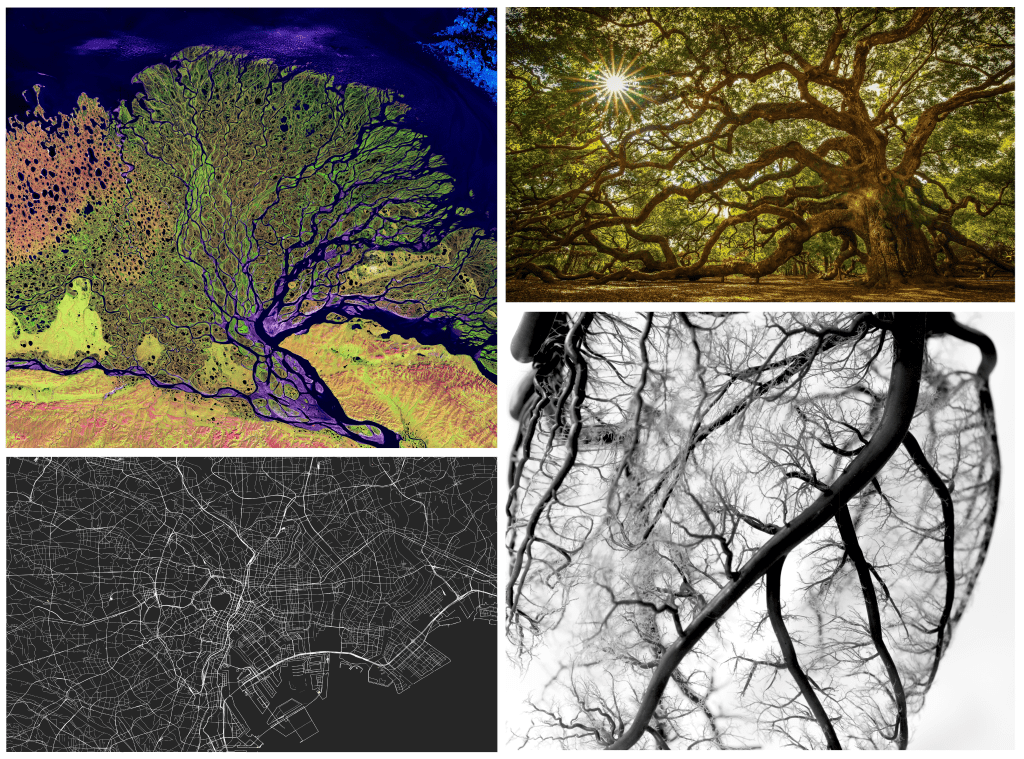
Nature is replete with fractals to an almost boring degree. But, interestingly, human systems such as roads, radio technology and even principles of aesthetics all follow fractal patterns. We can take it further. If we draw a map of every possible action and decision we could make in our lives, it would look very much like one of the images above. The whole image would represent the possibilities available to us at birth. Our actual life would be a small line that runs from the start and follows one branch to smaller and smaller branches, into the microscopic.
There is no direct path toward what we want to be or see or create. We find what we desire only as we experience life, when we take a step, or reach for something with the hand. Finding the perfect career has as much to do with taking the wrong jobs as much as it has to do with finding and taking the ultimate right one/s, for example.
Finding or being yourself is fundamentally comprised of movement and change. It may seem smart to take the most direct and efficient path (and to save time and money in the process). However, life is an unfolding of moments of passion, insight and regret. The indirect process is not the most efficient path to the end of your life; it will not save you from terrible mistakes, confrontation, bad feelings or loss. Nor will it spare you from deep love, unity, passion, delightful discovery and unspeakable joy. Moments of pause, of deep sadness or pure courage make for more than a life-they make for meaningful aliveness. It is the rough, unrefined movement from one feeling or action to another that constitutes the experience of living. It is wrought with change and inner conflict. Your identity is made up of who you are in all of these moments-in the way you tend to feel, tend to think and behave, and how you see and speak to yourself. You create yourself in this way.
Roughness is an inherent principle of nature. It is the generative process.
The Art of Roughness is the art of seeing a life from the highest possible view. It is to know that acceptance of the bad with the good is strategic and not forfeiture. It is the understanding that experience teaches and clarifies like nothing else, and that experience is earned through necessarily messy growth. Our lives and how we live them are precisely imprecise and perfectly imperfect.
You can push yourself to your edge and find the edge moves too. You define more of yourself by pushing, testing and acting on your anxieties. How one grows is not determined by one’s parents, lineage or culture-unless one allows it. Being alive is a highly individual process. It is impossible to describe in words or capture with an image. But here, I attempt just that-regardless of its inherent failure-because embracing that failure is roughness.
I want to be alive in all its fullness and I want to express what I think, feel and love. I don’t know what I’ll create. But, a life story can be told from infinite perspectives. The world and the people I love can know me deeply. But only here will my thoughts and feelings create a picture that is, in many ways, more intimate and accurate.
My personal expression of roughness is one where I become so precise that I find myself at the beginning time and time again. I find I do not know what I thought I mastered, and I find that I master what I think I do not know. As my ideas and feelings come together, and fall apart, I write. It is rough, but I don’t mind. This is my art of being.
 ArtofRoughness.com